
Weather
You are in the Himalayas, and the weather can change dramatically at a moment’s notice. One moment you are in sunny conditions, the next you are in a squall with no chance for seeing snow leopards, let alone photographing them. Such is the risk you take on a trip like this.
The sun is a mixed blessing. It does warm things up a bit, and of course it lights up the snow leopards with enough light for good focus and contrast, leading to a high quality photo. The trade off is the heat waves that are generated when the sun comes out, even at the well below zero temperatures.
These heat waves are magnified by the powerful telephoto lenses needed, causing so much distortion as to make many photos of poor quality, and sometimes even preventing focus in the first place. This can be quite frustrating after all of the effort put into finding even one snow leopard.
Altitude
The altitude of 14,000 feet substantially increases the risk of altitude sickness, which can lead to anywhere from fatigue and headaches to death due to pulmonary or cerebral edema. Our guides are acutely aware of this, and work on preventing this from happening in the first place.
It starts with acclimating, taking 3 days to go from the airport at Dehli to the homestay in Kibber at 12,ooo feet.
Next is taking a medication called Diamox (acetazolomide) for 2 days prior to high altitude and for another 3 days while there. You can learn more about this medication: https://pmc.ncbi.nlm.nih.gov/articles/PMC4276215/
The next important point is not to exert yourself at anytime in the first 1-2 days. That is easy since you cannot move very fast at this altitude and with all the clothes you are wearing.
Another thing is to drink more than usual since dehydration and altitude sickness go hand in hand.
Dr. P brought a pulse oximeter, and our main guide Santosh had one. We checked our oxygen saturation several times per day. A normal person at sea level has an oxygen saturation hovering around 95% or more. As it goes down to around 90% doctors start thinking about some type of 100 % oxygen supplementation.
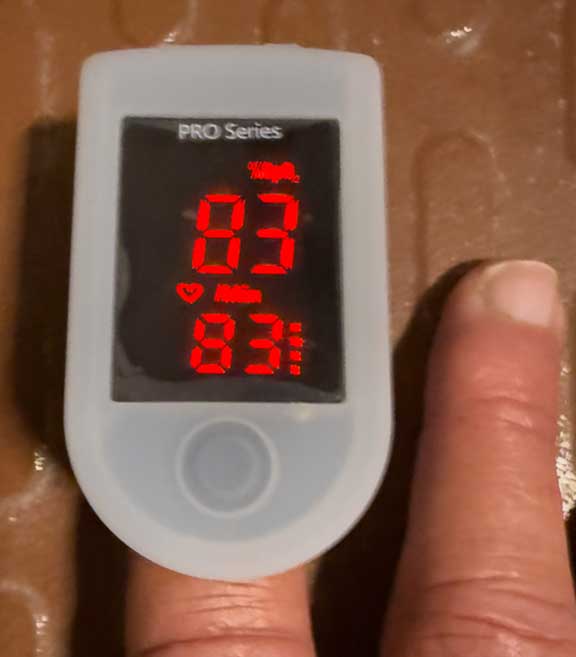
Dr. P’s oxygen saturation of 83% would panic a normal ER doctor at sea level in the U. S.
It is interesting to note that almost everyone on our group had an oxygen saturation in the mid 80’s, and even lower. It is when the oxygen saturation goes below 80 that you need to stay in for the day, not exert yourself at all, or even take supplemental oxygen that is available in small canister. If it does not improve, or if you feel weak, ill, or nauseous, your trip is over and you will be taken down the mountain to a lower altitude.
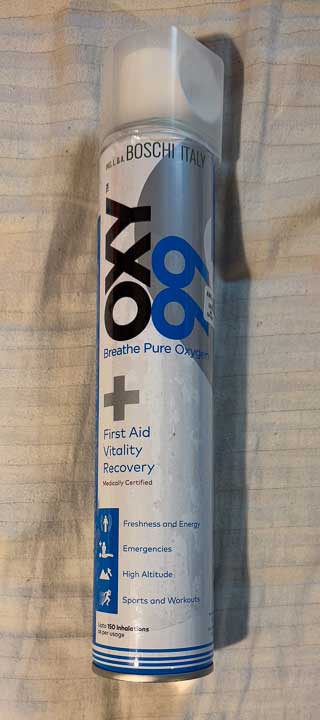
We had small canisters of emergency oxygen available as a precautionary measure
Temperature
It is brutally cold all of the time, and if the wind starts howling it can make it unbearable, so it goes without saying that you cannot skimp on your clothing.
In wildlife photography you are standing around for many hours waiting for something to appear or some type of action. It is hard to stay warm in a situation like this, and you need to wear many layers that can be adjusted accordingly.
This is an example of what Dr. P wore:
Head- 4 layers at various times
A lightweight full face mask cap.
A heavy hat
A neck warmer that goes over your face
The hood of the down jacket
Upper Body- 5-6 layers worn at various times as needed
First layer was Patagonia medium weight long underwear made of Capilene. This is the most important layer, so don’t leave home without it.
Next was a heavy flannel type of shirt.
Over that was a heated vest.
A lightweight full down jacket
Next came a down vest
Finally a heavy down jacket
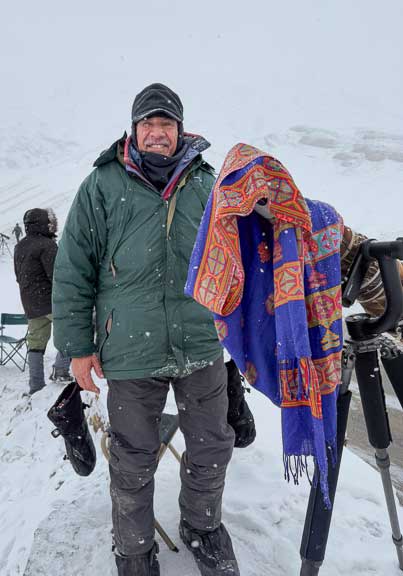
A cold and windy day with no sun means all layers are utilized
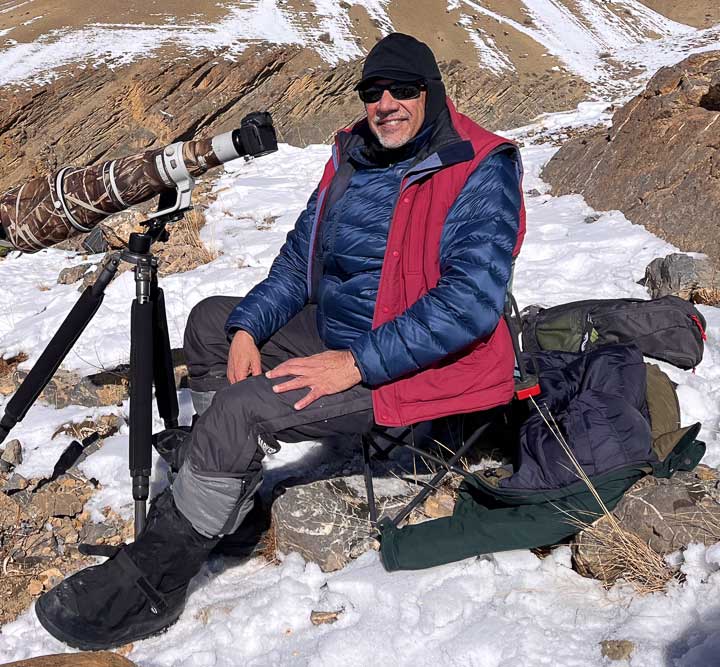
On a sunny day the radiant heat was enough to allow Dr. P to shed the last layer, the heavy down jacket. You can see it on the ground behind him. Note the heavy boots with nylon over covers.
Lower Body- 3 layers
Patagonia medium weight Capilene bottoms, with a heavy pair of pants, and then ski pants did the job.
Hands
Keeping hands warm in cold weather is always problematic for photographers. Heavy duty warm gloves can be worn but they impede the ability to use the camera controls. Most people bring hand warmers to put inside their gloves, so when they take the gloves off they can warm up their hands immediately after.
Dr. P used rechargeable hand warmers that worked well since they lasted most of the day and had variable heat settings.
Feet
Heavy socks and boots, with a nylon cover over the boots, worked well. The majority of time was spent standing or sitting, so it was important to move around at times to get the blood circulating to the extremities.
Terrain
It was steep and rocky in most places in order to get as close as possible to the snow leopards when photographing over the gorge where we set up our tripods right at the edge.
Walking around with heavy camera equipment would be dangerous, which is the reason each one of us was assigned a personal porter. These men were our heroes, and moved easily in the high altitude carrying heavy tripods and cameras.
Let’s learn about the photography equipment Dr. P used.