
The Arctic is a vast landscape, and polar bears are not inclined to pose for many pictures. This means that many photos need to be taken at a far distance.
This scenario necessitates two things:
Powerful telephoto lenses in the 600mm range (12x) with teleconverters to make them even more powerful. Anytime you use such a powerful telephoto lens you need to keep in mind two things:
A) It needs to be very steady, hence the common use of tripods
B) Heat waves, even in the fridge Arctic, will distort the photo
The ability to rapidly get in close to a polar, with the same rapid ability to get away if the bear does not want you near it and starts to charge you
The snowmobiles help in both of these areas. Their ability to carry camera equipment like large lenses and tripods allows us to bring heavy equipment. We can stop the snowmobile anytime, set up our equipment, and be ready to move away if a distant polar bear moves our way rapidly.
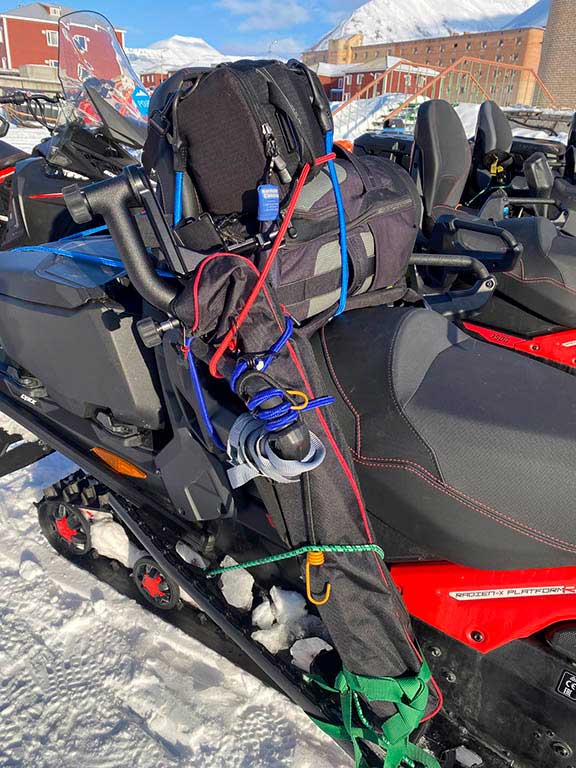
One driver, 2 camera bags, and a heavy tripod
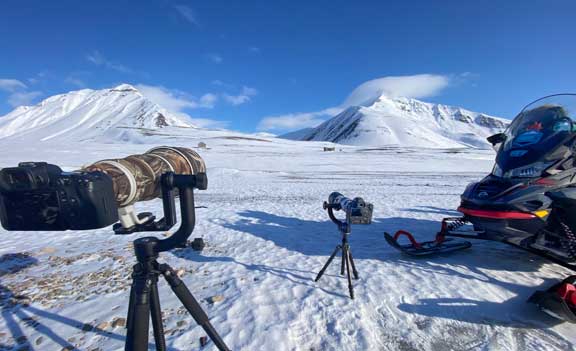
This is a typical setup as we take photos near our snowmobiles
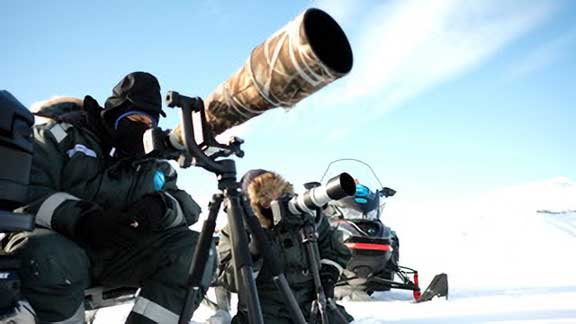
Dr. P targeting a polar bear with his telephoto lens
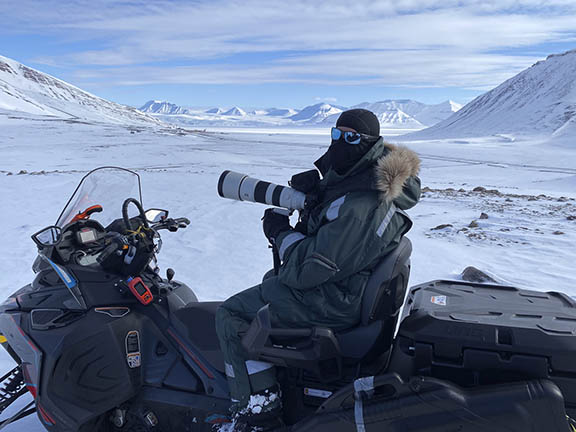
Sometimes we stop and take a quick photo without getting off the snow machine
When a bear is spotted in the distance, and Aaron thinks it is approachable, us guests leave our snow machines and get on the back of a sled that Aaron is pulling. He then approaches the bear at the speed and angle he thinks is best, and gets us close. We stay on the sled the whole time as we get near the bear, and when he stops and says to get off we set or camera equipment while he keeps an eye on the bear with the snowmobile running and ready to pull away in a second.
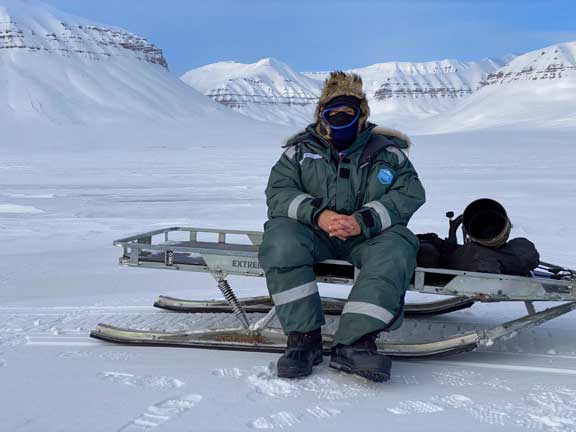
Dr. P, with telephoto lens out, getting ready to be pulled towards a bear
This video shows Dr. P in the sled as we are taking off to approach a bear. It is a bit of a bumpy ride as Aaron picks up speed!
The main reason us guests leave our individual snow machines and are pulled on sleds near the bear is for our safety. We can concentrate on our photography and not worry about jumping back on our snow machines as a polar bear charges us. The instructions from Aaron were quite clear. If he says to jump back on the sled and leave the camera equipment we are not to hesitate and try to get one more photo. We can come back later and get our camera gear.
As most people know, a female bear (called a sow) with a cub is very protective, and getting too close to a bear like this can invite a charge.
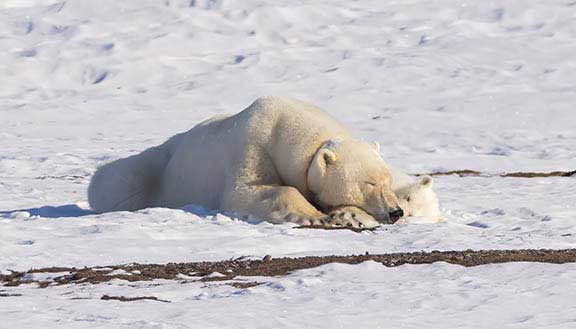
This technique allows us to get photos of a sleeping female and her cub
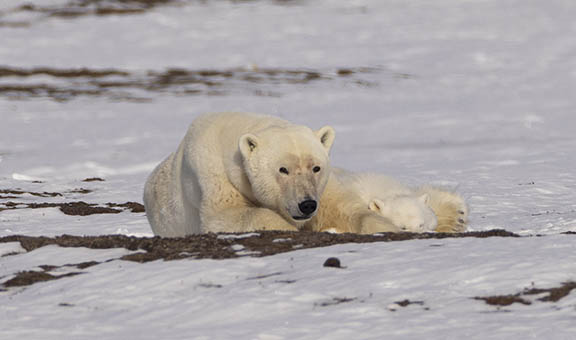
After a period of time she took more notice of us, but still remained calm
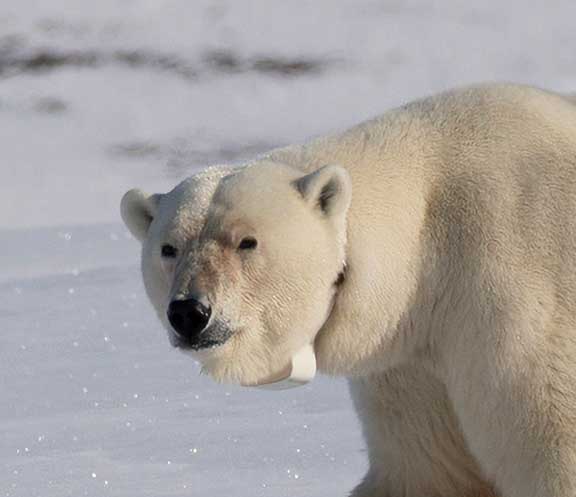
As she got up and walked away you can see her radio collar
This polar bear trip to Svalbard was in July of 2024. In October of that year Dr. P went to Canada near Hudson Bay to photograph the polar bears on a migration route. that blog post is next.